Showing posts with label Common garden birds. Show all posts

Friday, March 30, 2018

The Pied Triller's eggs

Eggs of the Pied Triller

Sitting pretty on its nest
 The challenge that I put myself was how to reach the Pied Triller's nest in order to see what's inside it?  I then decided to fix my cell phone at the end of a long bamboo pole.  The pole enabled  me to hoover the cell phone just above the nest.  Surprise! It was a most beautiful moment when I froze one frame of the video showing indeed two eggs inside the nest.  This is a lifer for me.
My next project is to lift the pole again when I see clear signs that the eggs are hatched. This may take a bit of time as I'm not sure when it will hatch it eggs, if ever it do.  Time will tell.
Below are more pictures of the Pied Triller.
Pied Triller next to its nest

Add caption

Pied Triller in flight

Thursday, May 18, 2017

Lively is the garden

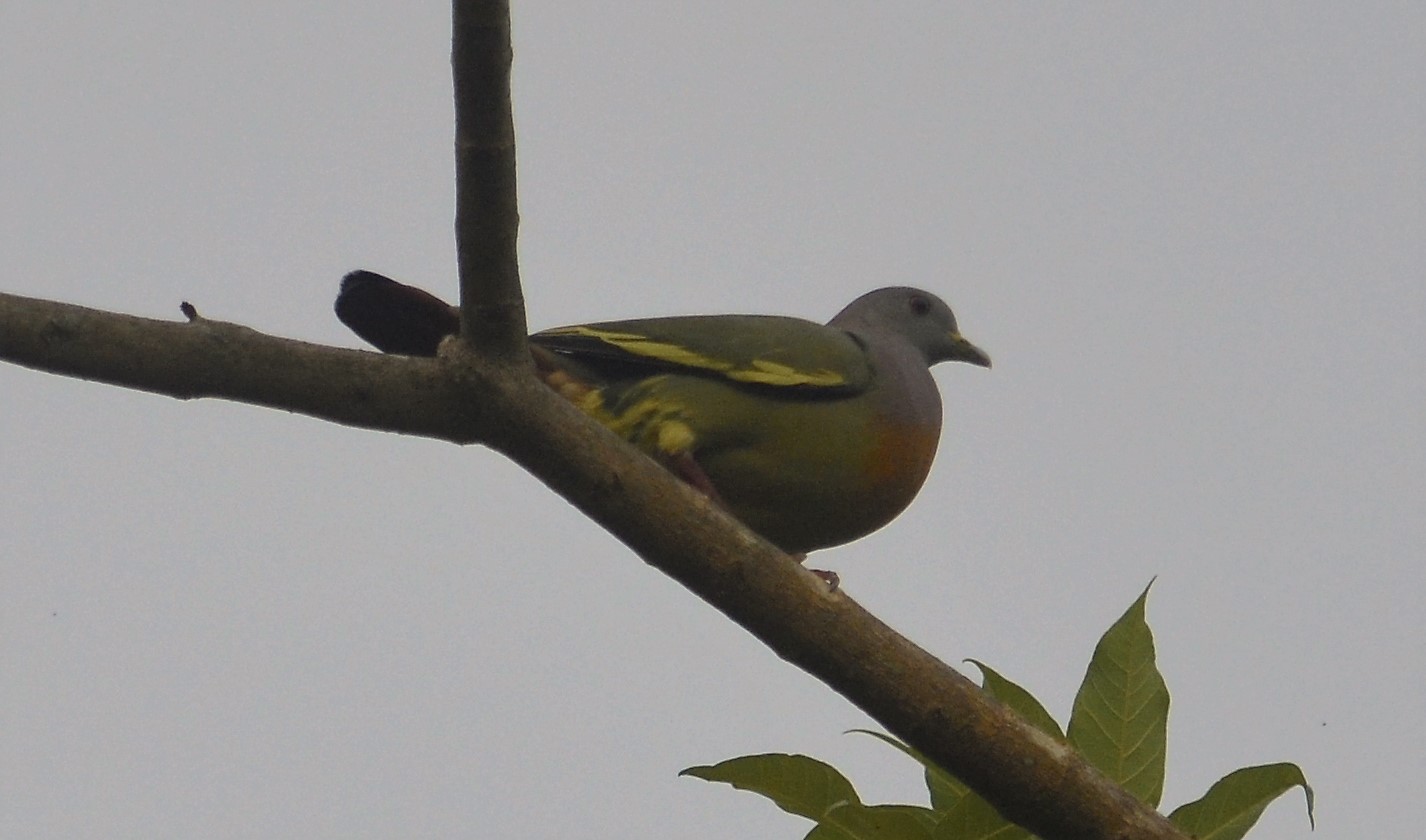
Pink-necked Green Pigeon

 As if by appointment the common garden birds of Kuching were there to greet me early this morning.  The brightly coloured  orange breast of the Pink-necked Green Pigeon roped in my attention to its natural beauty.  Not to miss the show two other birds that are part of the Kuching garden showed their presence too.  The Long-tailed Shrike and the Pied Triller make the garden busy with their unique calls making the garden lively.  I hope our stay in Kuching this May will see more of them closing in to the garden.
Long-tailed Shrike

Pied Triller

Tuesday, March 21, 2017

Chestnut Munia are abuzz

Chestnut Munia  roosting atop the Yellow Bamboo clump near the front porch.

  They zoom in and out of the bamboo clump next to the front porch hurriedly.  I noticed a small group of about 5 - 6 birds are currently busy building nests in the safety of the bamboo clump. These Chestnut Munia birds year in and  year out have found three such bamboo clumps in the garden as natural habitat for their nests.  I love these birds for their black hoods and well-groomed feathers.  Their deep brown body is very delightful to watch for the colour resembles tasty chocolates. Their stout, short and strong beaks are a great contrast to its black hood.  The beaks are apparently made for eating grass seeds.  These birds has been a permanent feature of the garden.


Thursday, January 26, 2017

Common birds in greener Kuching

White-breasted Waterhen

Pink-necked Pigeon

 On this trip many garden birds came to visit the garden with a few building homes. The Chestnut Munia, White-breasted Waterhen and the Pink-necked Pigeons are already claiming the status of permanent resident of the garden.  The environment must have been very conducive lately to have influenced them to make the garden a place called home.  On the sidelines, the daily visits of the White-breasted Woodswallow, Yellow-vented Bulbul, Brown-throated Sunbird, Peaceful Dove  and the Long-tailed Shrike are a constant reminder that the common garden birds of Kuching are here to stay.  Sighting these garden birds makes gardening in urban Kuching a delight and purposeful or meaningful.  Residential areas will become more appealing places to live as they help restore the natural environment for birds.  In this manner, a little step of creating home gardens come a long way towards building a greener and lively city jungle environments.

Long-tailed Shrike
Yellow-vented Bulbul

Brown-throated Sunbird
Peaceful Dove
Chestnut Munia

View of the Kambatik garden, Jan'17

View of the Kambatik garden, Jan'17

Wednesday, October 5, 2016

Good morning Shrike

Long-tailed Shrike (Lanius schach) broadcasting its sharp cracking call over the neighbourhood.

View of the Shrike from
 the  front garden
 The much-awaited bird came close to the garden this morning.  After hearing its call, I came out to the garden to locate its where about. Its sharp cracking call alerted me to its location.  Perching on an electric cable at the edge of the garden, its eyes were intent on the ground below probably sighting its prey.  It came in a party of three and when they re-grouped, their calls reverberated over the neighbourhood in joyful chorus.  This bird is peculiarly seen in Kuching and I find it rather difficult to see them in Bintulu.


Tuesday, October 4, 2016

Strong wings and an outstanding white breast

White-breasted Woodswallow

 This morning I feel strong because of a bird.  I have seen the White-breasted Woodswallow in many towns throughout Sarawak, preferring the overhead electric supply lines as their favourite perch. Its  stout body  is an icon of strength and agility.  I saw one perching next to the side garden this morning and for a brief moment did not notice my presence.  A small group of three were about the garden area and nearby electric posts to prey on insects.  At one occasion I noticed one of them making sorties to the ground and even rested on the lawn hopping and chasing the insects. I love these birds for their swift wings, grey body and an outstanding white breast.  Being swallows their flights are exceptionally acrobatic, targeted and pleasant to watch.  This bird now is very commonly seen at this housing estate and for that reason I have no qualms to include it in the list of common garden birds of Sarawak.

For a moment the bird was oblivious to my presence below.

The Great Frangipani (Plumeria obtusa) flowering well in the garden this morning.

Friday, August 5, 2016

Perching on the Poui tree


In late afternoon I encountered two birds that dropped by the 'Poui' (Tabebuia rosea)  tree at the back garden.  The tree has grown very tall over the years, taller than the yellow bamboo clump nearby.  I observed that the Pink-necked Pigeon has a nest at the bamboo clump and before it enters the nest would perch at the Poui branch.  The environment afforded by the dense bamboo clump and columns of leaves and branches have attracted many species of birds not only to build nest but also as source of food and playground.  The pigeon was joined later by the Olive-backed Sunbird which was intent to attract its mate by the continuous calls.  There is a fruiting Carpentaria palm next to the Poui tree and it has been observed that the Pink-necked Pigeon do have a liking to its ripe fruits.


Female of the Olive-backed Sunbird, looking for its mate

A fruiting Carpentaria palm located next to the Poui tree

Ripe fruits of the Carpentaria palm.

Thursday, August 4, 2016

Long-tailed Shrike comes a calling

Long-tailed Shrike at back garden

 As if to check out our arrival the uniquely Kuching bird was the first to greet me early in the garden this morning.  The Long-tailed Shrike ( Lanius schach) was clinging to the very tip of the bamboo branch while uttering its loud call.  It's easy to spot it because of the clarity and high volume call it gives out over the neighbourhood.  It was after sighting me on the ground below that it decided to take flight.  Its  brief visit makes me feel very much comfortable already.  Yes, good morning Kuching!
The Long-tailed Shrike took off after sighting me below

Minutes later the Yellow-vented Bulbul echoed the morning cheerfulness.

Tuesday, May 24, 2016

Tiny sunbirds in the garden today

Brown-throated Sunbird at the Drunken Sailor 0r Rangoon Creeper flowers.


Crimson Sunbird

Tiny birds in the garden this this morning.  Brown-throated Sunbird and Crimson Sunbird'

Monday, May 16, 2016

New bird sighted in the garden

Pied Fantail (Rhipidura javanica) on the Poui branch
Location : Side garden
 I have not seen the Kuching birds namely the Pied Triller and the Long-tailed Shrike visiting the garden yet. However, the new sighting of the Pied Fantail makes up for their absence.  This is the first time that the bird is seen visiting the place.  I noticed that it comes here with its mate, dropping very early in the morning and occasionally would re-visit the place in the late afternoon.  It is a nervous and panicky bird with a suicidal behaviour. I mean it will not stay still for long and would attempt to drop several branches down in suicidal fashion.  It utters a clear whistle that is fair to the ears. Oh, by the way, its suicidal behaviour has made the Malays call this bird " Murai Gila"! ( "Gila" means mad or crazy.)