Showing posts with label Laman Kambatik. Show all posts

Friday, August 12, 2016

Bright purple covers

Seribu Bahasa (Berawan) - Centratherum punctatum, grown as cover

 I have been experimenting with the Seribu Bahasa as a cover plant in Bintulu as well as in Kuching.  At both places the result were pleasing.  Here at Kambatik garden, I find today that the plant grown in a small mass looks  very healthy and flowering well.  The bright purple flowers attract the Eggfly butterfly.  The ethnic Berawan people of Sarawak call this plant 'Seribu Bahasa'.  I saw the plant growing wild initially  at the Kambatik Park in Bintulu from which I got the initial stock for propagation purposes and brought some to Kuching.  My planning for the Kuching garden is therefore to plant more of this species for covers and skirting since the plant seems to manage well in open sun and semi-shade locations.

Grow them in small masses and feed them well to obtain abundance of flowers

Reds in the garden

Ripe fruits of the Carpentaria palm at the front garden

Red Hibiscus at the back garden

Red Ti or Cordyline 'Firebrand'

CU of Red Cats' tails (Acalypha hispida)

Red hot Cats' tails

Red Ixora at side garden

Tuesday, August 9, 2016

The Foxtail palm in semi-mature form

Foxtail palm (Wodyetia bifurcata) to help provide the exotic tropical  look.

Red Sealing Wax palm
(Queen of Sarawak Palm) grow in clumps
at front garden. 
 It is of no mention that in any Kambatik garden (Malaysian garden) there must be some sight of a palm tree or many.  True to the concept of the Malaysian garden I have planted various species of palms in the garden to exude the exotic tropical look.  Of course the Queen of Sarawak palms is the Red Sealing Wax palm or Pinang Lakka according to some quarters.  Yes, we have a good number of them in the garden for the colourful red to orange crown shafts they brilliantly show.  A late introduction in the garden is the Foxtail palm (Wodyetia bifurcata) which is not a native palm but nevertheless attractive for its compound feather-like  and fish-tailed leaves. The three trees planted here are semi-mature and it would take a couple of years for them to produce flowers or inflorescences.  There are solitary palms grown in the garden from seeds, thus there is no  material cost involved.  The Red Sealing Wax palm on the other hand has a clumpy habit with side shoots that grow uninterrupted.
A Foxtail palm in semi-mature form amidst garden greenery.

Sets of compound feather-like leaves resembling fox tail with several fish-tail leaflets.

Monday, April 4, 2016

Tropical and lush greenery at the front garden

Yellow Palm, Carpentaria Palm and Red Sealing-wax Palm at the front garden
 The front garden is looking luxuriously tropical with its many varieties of palm trees.  Colour is provided by the Eugenia oleina tree, flowers of the Drunken Sailor, fruits of the Carpentaria palm and crown sheaths of the Red Sealing-wax palm.  The yellowish feather-like leaves of the Yellow Palm is also attractive in its on way.  Interestingly the Drunken Sailor has managed to hold on to the tall Carpentaria Palm.  Finally I think I have achieved what I wanted to create at the front garden.  A composition of luxury, evergreen and colourful nature to be enjoyed every day throughout the year.
Drunken Sailor (Quisqualis indica) scrambling over the Eugenia oleina tree
( Note: This is a re-posting.  For full story and images, please follow this link ....>>>http://mygardeningprojects.blogspot.my/2014/08/tropical-and-lush-greenery-at-front.html )

Two yellows and a Penda

A maturing garden - attracting attracting the 3 B's ( birds, butterflies and bees)
Note the Golden Penda yellow flowers at the top centre of the picture.
 What's interesting on this trip (44th trip to Kuching) is to see the garden gradually maturing.  For one thing the trees are getting taller and giving out much shade and shelter to the birds. The lawn is steadily thickening and spreading out to areas that were lately developed.  Three yellow flowers caught my eyes today.  They are the flowers of the Yellow Bells ( Tecoma stans), Cassia biflora and the Golden Penda (Xanthostemon chrysanthus).

 The sights and sounds of a maturing garden are evidenced by the presence of 3 B's - birds, butterflies and bees, not forgetting other insects that would like to join in the list like the grasshoppers and  beetles.
The flowers that bloom for the first time are Golden Penda ( Xanthostemon chrysanthus) and we felt rewarded now by our effort to introduce this plant in the garden nearly two years ago. 

( Note: This is a re-posting.  For full stoy and images, please follow this link...>>>http://mygardeningprojects.blogspot.my/2013/08/two-yellows-and-penda.html )

Colour the garden

Living in an evergreen tropical climate one's eyes is constantly washed by the refreshing and healing colours of green. Often times when I enter a room or an office my eyes are naturally attracted to live plants that would indicate to me that there is live, growth or stability in the living or work place I am part of. Green is easy on the eye.
Still, we do need colours in our lives just as we need them to add vitality, appeal, sparkle and warmth to the garden. The green wash is considered a 'cool colour' and it is the hot or warm colours that we need to paint the garden to make it look vibrant and invigorating. After about a year since we started digging and experimenting with our garden in Kuching, some positive results are showing up. My focus today is flowers of the red hue( fully saturated). Add a little white and the redness dissolves into more pink values (tints) and here I have planted a couple of species like the heliconia 'sassy pink', pink hibiscus and pink frangipani that hopefully would tickle my senses ( see inset above).
The green wash of the small lawn, palm leaves and shrubbery at the front garden gives out much oxygen and freshness. Besides the the overall greeness, I have added darker values of red ( shades ) to the lower storey plants, thus the dark red or maroon leaves of the irisine. Even the wild banana leaves are variegated with blood red shades of colour.
Pink Hibiscus
In order to enjoy the garden early my strategy was to complete the front garden first. The side garden and the back garden would evolve later. Presently I plant all sorts of species at the back garden as 'advance nursery' which would provide me with the required quantities and heights of the plants upon transplanting . This method is cost saving because you get to propagate the plants yourself instead of purchasing them which is not cheap considering the quantities involved later.
Above, I use a lot of the highly variegated coleus species ( darker shades of red) as under storey plants for the side garden which is slowly emerging.
Having spent a good morning walk about at my garden , I was delighted to make fresh cuttings of the frangipani, hibiscus and heliconia that make their starring performances today. As a test to my kambatik garden concept, I would put it that in our rich tropical diversity, one should be able to move out of the house and within minutes make a simple composition for the table. I attempted it just now and pleased to call this composition 'My Pink Lady'. For more fast compositions of floral arrangements from the kambatik garden please browse here.

( Note: This is a re-posting.  For full story and images, please follow this link ...>>>http://mykambatikworld.blogspot.my/2009/02/colour-garden.html )

A Kambatik garden pyramid

Varying foliage and colours in the Kambatik garden.  With flowers we sense the changing times and seasons.
I like to look at  a garden like viewing a pyramid.  At the bottom level is the architecture, another row up is the environmental sustainability and the very top of the pyramid is pleasure.  We start first by thinking from the basic building block of space planning, choice of texture, shapes and colours for these constitute the the architectural aspects of the garden.  Combining the contrasting leaves forms and textures help obtain a distinctive exotic and tropical image.  For instance, large or broad leaves can be combined with structural plants like palms.  The flowers and foliage can recreate the feelings or mood of change of seasons. Most importantly plant trees, trees and trees because trees are the urban lungs. Columns of biomass around our house provide better micro-climatic comfort and oxygen.  Without trees we have no future. Simple as that.   Next in the environmental sustainability come the important denizens of the garden, principally the wildlife from the lowly earthworms to those high above the trees mainly the birds, butterflies and bees.  These group of garden creatures are our "voiceless" neighbours with which we should care and collaborate with.  They need us to give the freedom to build their nests, provide food (edible landscaping) and branches to preen and play.  In the process the garden becomes a nature sanctuary for food, foliage and fun for the wildlife.  Finally, at the top of the pyramid view is the pleasure we get from both active and passive recreation.  In active mode we sweat in bodily welfare from excercise and working out in the garden.  Most important is the inspiration that the garden can give us.  In reflective mood we begin to find the feeling and sense of beauty of the place and nature in particular.  That is it! The garden is a step into paradise. Therefore, create your own Kambatik garden.  It is never too late to create paradise on earth especially if you believe that ours is a blue and green planet.

( Note: This is a re-posting.  For full story and images, please follow this link...>>>http://mygardeningprojects.blogspot.my/2016/02/a-kambatik-garden-with-broad-leaves.html )

The maturing Kambatik garden

View of garden
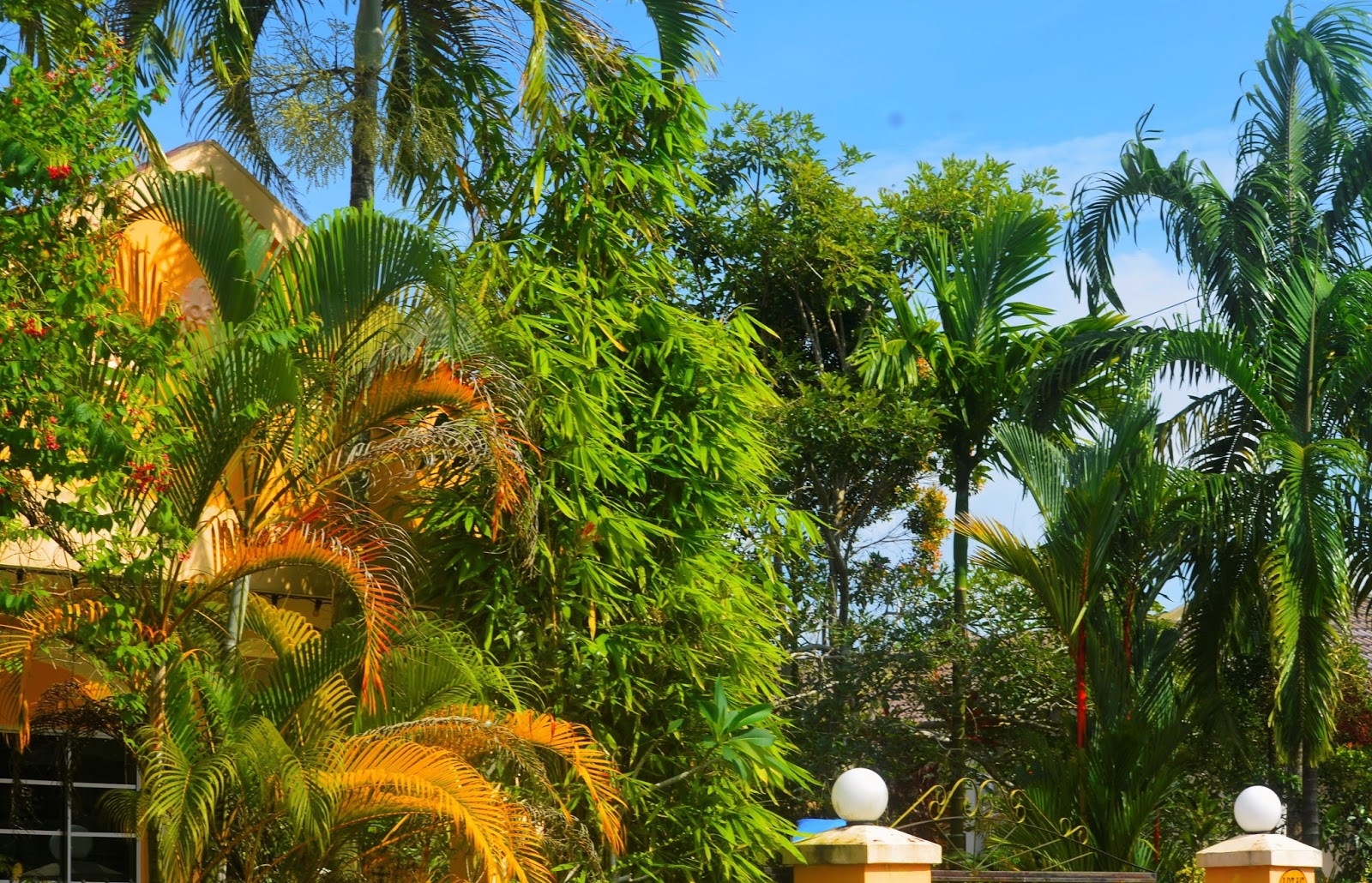
On this visit the garden looks luxurious, tropical and exotic.  Swaying palms, bamboo leaves, use of broad leaves, colours from flowers, climbers and sheaths of the Red Sealing Wax palm and tall trees help make the garden cool yet colourful.  The columns of greenery provides much sanctuary for wildlife especially the common garden birds here.
( Note: This is a re-posting.  For full story and images, please follow this link ....>>>>http://mygardeningprojects.blogspot.my/2016/01/the-maturing-kambatik-garden.html )

Looking beyond the Kambatik garden

Bringing nature outside the bedroom
View from main garden, looking west.  Note the mountin range in the far horizon.
Occasionally we need to re-focus our sight.  Beyond the Kambatik garden (Malaysian garden defined) I see the distant hills, with bluish green cover.  Further still the mountain range seemed a formidable soft barrier of blue.  The expanse of sky and open air beyond reminds me of nature's kindness, giving life and hope in an encompassing universe that needs to be conserved for the future generation.  It prompts to ask 'What have you done to your country, if you say you love your country?'  Closer to home, I see the football fields and the green open spaces of the neighbourhood.  There are trees that adorn the streets and the fields.  It is a connected world.  The Kambatik home garden is but a tiny sanctuary in urban green lung.  The prime idea however is its role in the passageway of nature's big corridor of wildlife and the plant kingdoms we needed most to be alive and kicking.  We need to build home gardens to provide transit and temporary home to some of nature's wildlife species as they travel and forage for food.  Without plants and wildlife human will naturally die.  With nature humans prosper.  Do a Kambatik garden if you are a Sarawakian, and soon.  Very immediately you'll partake in nature's power and glory.  Look beyond the Kambatik garden!

Sunday, April 3, 2016

The Malaysian garden defined

View of Kuching Kambatik garden looking north-east
25 March'15

The side garden is attaining the image of the Kambatik garden now.  The cascading network of long violet or purple sprays of theCongea velutina is a crowning glory to the Malaysian garden.  This plant has been trained to climb the tall 'Lumok' tree with its leaves providing broad shapes in the garden landscape canvas.  The flowers are actually small but it is the four petal-like bracts of theCongea velutina that provides the colour.  The garden too is a grove of various palms and columns of trees with attractive colours when in flower.  Striking foliage colours provide permanent colours to the garden in many hues from  pale yellow  to red .  The thick greenery around the house is home to a growing list of many nesting birds and fruiting trees.  It provides an inviting passageway to visiting birds, butterflies and many other representatives of the insect world by day.  This is the garden character that is definitive of the Malaysian garden which I have researched over a decade and defined as the Kambatik garden.  It is a garden sanctuary of wildlife, a micro world of the original forest once gone, a place in the sun where shade creates a micro-climate conducive to many passive and active recreation under the tropical sun and a source of edible fruits and medicinal herbs within an arm's length.  What more could Malaysians ask?
For those interested to know the full list of plants suitable for the Kambatik garden can check the plants lists which I have shared online in the following blogs shown below:-
( Note: The page views indicated below are as at 26 March'15.) 
All the plants (4th Ed.)  -  10,608 page views
All the Plants (3rd Ed.)  -  203,442 page views
All the Plants (2nd Ed.) -   30,913 page views
All the plants (1st Ed.)   -  54,258 page views

( Note: This is a re-posting from my Gardening projects blog.  For full story and images please follow this link ....>>>>http://mygardeningprojects.blogspot.my/2015/03/the-malaysian-garden-defined.html