Showing posts with label Palm trees. Show all posts

Sunday, May 24, 2020

Main garden progress as at 25 May, 2020.

The main garden with fruit trees e.g. Cononut, Starfruit, Kedondong, longans etc..
View as at 25 May ,2020.

Burnign spot at the Main garden.
 The main garden is the middle garden. Two sections are relevant.  First the area in the middle where the big trees especially the fruit trees are planted. Second, there is the area next to the car porch planted with palms, flowering shrubs and covers.
The heliconia species are doing well and top on the list are the Heliconia latispatha and Red Lobster's Claw.
The main garden is a place of shade and also a burning spot.
The Staghorn fern is doing well, so are the Ivora shrubs.
Red Golden Penda.

Heliconia Red Lobster's Claw.

Heliconia latispatha.

Staghorn fern

Wednesday, October 5, 2016

The garden palms

The Carpentaria palm heavily fruiting at the front side garden. At right, partly seen is the Pinang Lakka

Sea Cycas or Cycas rumphii
 The Malaysian garden is nothing without palms of which the Pinang Lakka or Red-Sealing Wax palm (Cyrtostachys renda) is queen of them all. The Kuching garden is sufficiently covered at many spaces with this palm and many others as well.  A well-deserved palm to be planted in any Malaysian garden is the Sea Cycas (Cycas rumphii) which exhibit rigid feather-like leaves.  It grows well at coastal locations in Sarawak.  At the front porch is located the Butterfly Palm, variously called as Golden  Cane Palm, or simply Yellow palm (Chrysalidocarpus lutescens).  This palm is appealing for its slender leaves and stems that bend gently in the breeze.  A recent  import to the garden is the Foxtail palm ( Wodyetia bifurcata) which is somehow famed for its pretty  'fox-like' tail fronds, planted initially from seeds I collected from friends.  The three specimens in the garden are growing well and are about twice the human height already.  Finally is the planting list of palm species in garden here is the Coconut palm which every human in this planet is familiar with,  I planted the tree mainly for its fruits which are just starting to form after the flowering last month.  Truly I really enjoy the garden for its palms.
At left are the fruits of the Carpentaria palm and at right the attractive leaf sheaths or crown shafts of the Pinang Lakka.

At left is the Golden Cane Palm (Chrysalidocapus lutescens) with slender leaves and stems

A row of Foxtail palm planted closer to the house, with tall Carpentaria palm in the background. 

A collection of sorts with the Butterfly palm at left and the Pinang Lakka at right.

The Coconut palm at the side garden.  The picture is taken today when I did some 'smoking' to the garden.

Tuesday, August 9, 2016

The Foxtail palm in semi-mature form

Foxtail palm (Wodyetia bifurcata) to help provide the exotic tropical  look.

Red Sealing Wax palm
(Queen of Sarawak Palm) grow in clumps
at front garden. 
 It is of no mention that in any Kambatik garden (Malaysian garden) there must be some sight of a palm tree or many.  True to the concept of the Malaysian garden I have planted various species of palms in the garden to exude the exotic tropical look.  Of course the Queen of Sarawak palms is the Red Sealing Wax palm or Pinang Lakka according to some quarters.  Yes, we have a good number of them in the garden for the colourful red to orange crown shafts they brilliantly show.  A late introduction in the garden is the Foxtail palm (Wodyetia bifurcata) which is not a native palm but nevertheless attractive for its compound feather-like  and fish-tailed leaves. The three trees planted here are semi-mature and it would take a couple of years for them to produce flowers or inflorescences.  There are solitary palms grown in the garden from seeds, thus there is no  material cost involved.  The Red Sealing Wax palm on the other hand has a clumpy habit with side shoots that grow uninterrupted.
A Foxtail palm in semi-mature form amidst garden greenery.

Sets of compound feather-like leaves resembling fox tail with several fish-tail leaflets.

Friday, August 5, 2016

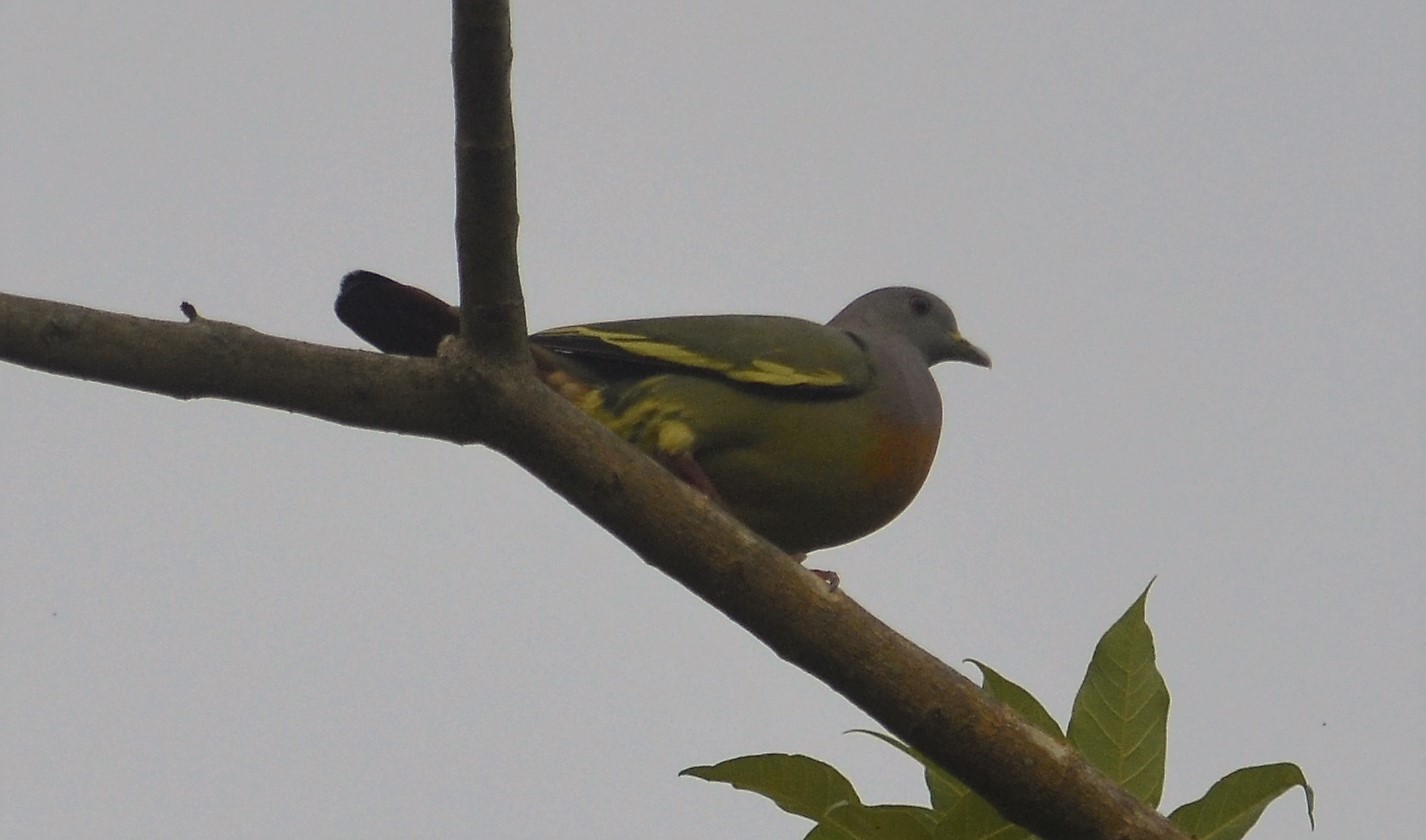
Perching on the Poui tree


In late afternoon I encountered two birds that dropped by the 'Poui' (Tabebuia rosea)  tree at the back garden.  The tree has grown very tall over the years, taller than the yellow bamboo clump nearby.  I observed that the Pink-necked Pigeon has a nest at the bamboo clump and before it enters the nest would perch at the Poui branch.  The environment afforded by the dense bamboo clump and columns of leaves and branches have attracted many species of birds not only to build nest but also as source of food and playground.  The pigeon was joined later by the Olive-backed Sunbird which was intent to attract its mate by the continuous calls.  There is a fruiting Carpentaria palm next to the Poui tree and it has been observed that the Pink-necked Pigeon do have a liking to its ripe fruits.


Female of the Olive-backed Sunbird, looking for its mate

A fruiting Carpentaria palm located next to the Poui tree

Ripe fruits of the Carpentaria palm.

Tuesday, May 24, 2016

"Makan sirih" and the origin of Penang

Ingredients for 'Makan Sirih' - Betel or  "Sirih"  leaves ( Piper betel ), Kapur ( lime) and  Pinang fruit or areca nut  ( Areca catechu) and a mixture of spices

Front side garden
 The palm tree at the side garden is bearing fruits.  This tree is the reason why Penang was called "Pulau Pinang' to mean island of Pinang trees.  The scientific name of this tree is Areca catechu.  Many civilisation in the world are familiar with this fruit especially Indian and the Malay world civilisation.  It is habitual among Indians and Malays to consume the areca nut by chewing it with other ingredients mainly the Betel leaves (Piper betel), lime or 'Kapur' (Malay) and a mixture of spices ( e.g. ketumbar, jintan manis/ jintan hitam, akar 'tahi angin' (Radix usnea), etc.).  In the top picture, I have arranged the ingredients for the culture of eating the areca nuts with other combinations which custom is called "makan sirih" in Malay.  No makan sirih is complete without the Betel leaves, lime and spices.  In fact because of this cultural practice many have mistakenly called the Pinang tree as the 'Betel nut' palm. Scientifically betel is a herbal plant  belonging the piperaceae family whereas the Pinang tree's botanic name is Areca catechu and therefore the Pinang fruit/nut should properly be called 'Areca nut'.
The areca nut cut in half.  The seed or nut need to be sliced or pounded for easier chewing.

The ingredients ready to be wrapped in the betel leaf for chewing.